Marble and Stone Care in Malibu, Calabasas and Beverly Hills Estates
How sand, salt air, hard water and pool decks wear down marble, granite and travertine in Malibu, Calabasas and Beverly Hills, and how to protect them.
On this page
Marble and natural stone wear out for local reasons. In Malibu it is sand and salt air. In Calabasas it is hard water, pool decks and long dry summers. In Beverly Hills it is foot traffic, entertaining and polished floors that show every mark. The stone is the same everywhere, but what damages it changes with the address. This guide covers how marble, granite, travertine and limestone are cared for in each of those three areas, what protecting the stone looks like week to week, and when a specialist should take over. For the general method, our guide to cleaning marble and natural stone covers the basics.
Why does marble need protection and not just cleaning?
Because most of the damage to marble is permanent. Marble, travertine and limestone are made mostly of calcium carbonate, which reacts with acid. Lemon juice, wine, vinegar and many all-purpose sprays leave an etch, a dull spot where the polish has been eaten away. That is not dirt on the surface. It is a change in the stone, and no amount of wiping removes it.
Marble is also soft. Calcite, the main mineral in most marble, rates 3 on the Mohs hardness scale, while quartz, the main mineral in ordinary sand, rates 7. Every grain carried in on a shoe works like sandpaper. A cleaning visit that only removes what is visible leaves those two problems in place. Protection means keeping acid and grit away from the stone before they cause damage, and catching early wear before it needs restoration.
That is the difference between a house cleaner and a team that cares for luxury finishes. The first wipes the counter. The second knows which counter is honed Calacatta, which one is granite, and which product would ruin each of them.
How do the main stones in a luxury home compare?
Each stone behaves differently, so the first step in any home is identifying what is installed and where.
| Stone | Acid-sensitive? | Main risk | Where you usually find it |
|---|---|---|---|
| Marble (Carrara, Calacatta, Statuario) | Yes | Etching, scratches, staining | Entry halls, baths, kitchen islands, fireplaces |
| Travertine | Yes | Etching, dirt trapped in open pores | Pool decks, patios, showers, stairs |
| Limestone | Yes | Staining from oils and water | Floors, outdoor walls, bath surrounds |
| Granite | Mostly no | Staining when the sealer is worn | Kitchen counters, outdoor kitchens |
| Quartzite | Mostly no | Sealer wear, sometimes confused with marble | Counters, waterfall islands |
Two practical notes. Granite and quartzite resist acid better, but they are still porous and still need a sealer. And some stones sold as quartzite are actually marble or dolomite, so it is safer to treat an unknown stone as acid-sensitive until it is confirmed.
FJ Luxury Services
Give your home a true top-to-bottom reset by a white-glove team — explore our deep cleaning services in Los Angeles.
What wears down stone in a Malibu home?
Sand and salt. Homes near the beach bring in fine sand on every pair of shoes, every towel and every pet. On polished marble floors that sand leaves a haze of fine scratches, starting at the doors that lead to the beach or the deck. Salt air leaves a film on outdoor stone and glass, and on metal fixtures set into stone.
What protects stone in Malibu:
- Dry removal first. Dust-mopping or vacuuming with a soft head before any damp cleaning, so grit is lifted rather than dragged.
- Entry control. Mats inside and outside the beach and deck doors, cleaned often, and a place to rinse feet and gear outside.
- Fresh-water rinse outdoors. Outdoor stone and the stone around outdoor showers rinsed with clean water so salt does not build up in the pores.
- Closer attention to sealers on outdoor stone, which sees sun, salt and water every day.
Malibu homes that also run as rentals face this twice as often. We cover that side in our Malibu vacation rental cleaning guide, and the area itself on our Malibu page.
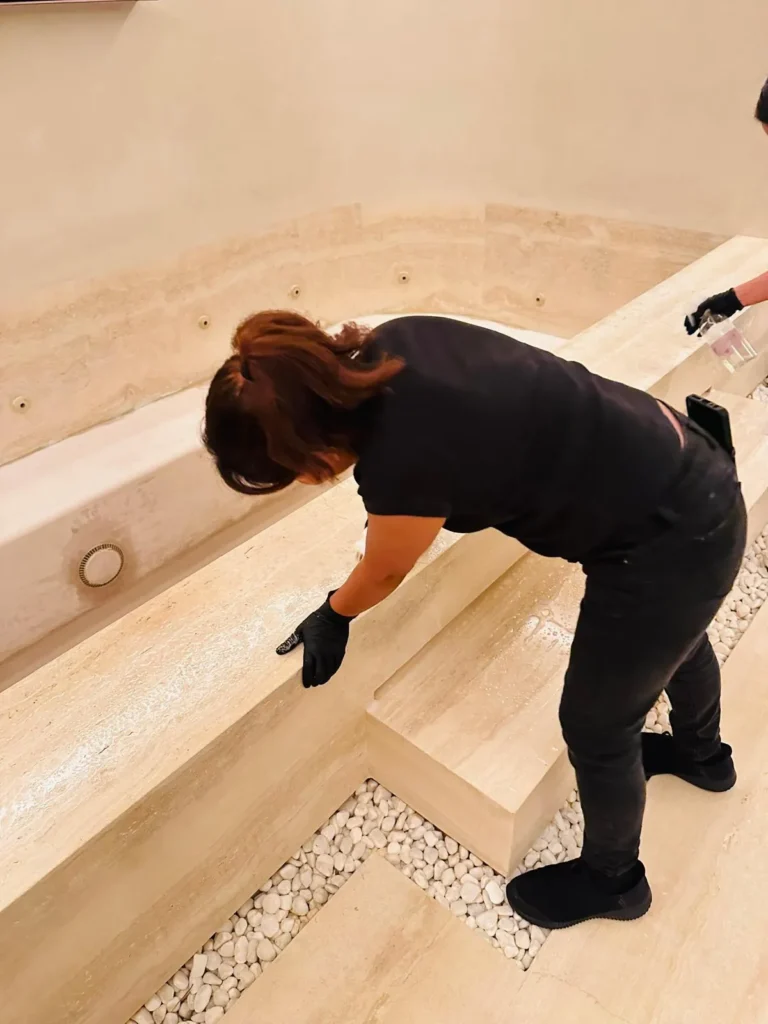
What wears down stone in a Calabasas home?
Water, heat and pool chemistry. Calabasas sits inland in the Santa Monica Mountains foothills, with hot, dry summers and large homes built around outdoor living. Three things show up again and again:
- Hard-water spots. Much of Southern California’s tap water is hard, although it varies by water source. Sprinklers, pool splash and shower water leave white mineral marks on stone, and on polished marble the wrong descaler etches the stone while removing the spot.
- Pool decks and coping. Travertine around pools collects chlorinated or salt water, sunscreen and leaves. Its open pores trap dirt, and harsh cleaners can damage it.
- Dust from dry hillsides. Fine dust settles on outdoor kitchens, patios and the floors right inside sliding doors, and acts like the beach sand of the coast.
Care here means removing mineral deposits with products made for natural stone, rinsing pool-side stone after heavy use, and keeping sealers in good condition on outdoor surfaces. Our page on house cleaning in Calabasas covers regular service in the area, and our guide to Calabasas gated communities covers access and HOA rules.
What wears down stone in a Beverly Hills home?
Traffic and entertaining. Large polished marble entries, formal dining rooms and bars see guests in street shoes, spilled drinks and catering crews moving tables and carts. The typical damage is a dull path through the entry, rings from glasses on bar tops and tables, and etch marks from citrus or wine that sat overnight after an event.
What protects stone in Beverly Hills homes:
- Coasters, trays and felt pads before an event, and a walk-through of stone surfaces the morning after.
- Spills blotted quickly, not wiped, so acid and color do not spread.
- Runners or temporary floor protection on the catering route when the event is large.
- A clear note for every vendor who works in the house about which surfaces are marble.
For homes that host often, our guide to holiday hosting prep lists what to protect before guests arrive, and our Beverly Hills estate cleaning guide covers the wider home.
What does weekly stone care look like in practice?
Most of the protection happens on ordinary visits, not on special ones. The routine below is what we follow on stone in an occupied luxury home:
| Frequency | Task | Why it matters |
|---|---|---|
| Every visit | Dry dust-mop or soft vacuum on stone floors before damp cleaning | Stops grit from scratching the polish |
| Every visit | pH-neutral, stone-safe cleaner on counters, vanities and floors | No etching, no residue |
| Every visit | Dry buffing of polished surfaces with a clean microfiber | Prevents water spots and streaks |
| Every visit | Check for new etches, stains or chips and report them | Small problems are caught early |
| Monthly | Rinse and detail outdoor stone, pool coping and outdoor kitchens | Salt, chlorine and minerals do not build up |
| Seasonally | Water-drop test on counters and high-use stone | Shows when the sealer is wearing out |
The water-drop test is simple: leave a few drops of water on the stone for several minutes. If the stone darkens, it is absorbing water and the sealer needs attention. How often to polish or re-hone is a separate question, answered in our guide on how often to polish marble floors.
Which products and habits damage marble the most?
Most stone damage in a luxury home comes from well-meant cleaning with the wrong product. The usual suspects:
- Vinegar, lemon and any cleaner marketed as citrus or “natural acid”.
- Bleach, ammonia and general bathroom or glass cleaners not labeled safe for natural stone.
- Abrasive powders, scouring pads and the rough side of a sponge.
- Steam or very hot water on stone with a worn sealer or on old grout.
- Standing water left after mopping, especially on limestone.
- Rubber-backed mats that trap moisture against the stone.
That is why stone care instructions from manufacturers call for pH-neutral cleaners made for natural stone. The same rule appears in our marble floor care guide, which goes deeper into polishing and stain removal.
When should a stone specialist take over?
When the stone itself has changed. A trained cleaning team can keep stone clean, protect it and report problems, but some work belongs to a stone restoration specialist:
- Etches that you can feel with a fingernail or that cover a large area.
- Deep oil or rust stains that come back after cleaning.
- Re-honing or re-polishing a floor that has lost its finish.
- Cracks, chips, loose tiles or failing grout lines.
- Full resealing of large floors or outdoor stone.
Part of our job is knowing where that line is and telling you honestly. In a house management arrangement, we also schedule the specialist and check the result. See our house management service for how that coordination works.
How does FJ Luxury Services care for stone in these areas?
We are a luxury cleaning company in Los Angeles, but the work is closer to care than to cleaning. We don’t just clean your estate; we protect it. In practice that means:
- A confidential walkthrough first, where we note every stone surface, its finish and its condition.
- The same assigned team on every visit, so the people cleaning your marble know your marble.
- Stone-safe products and dry-first methods, matched to each surface.
- Reports of new wear, so you hear about an etch the week it appears and not a year later.
- Staff who are employees, background-checked and covered by an NDA before their first shift.
We serve Beverly Hills, Calabasas, Malibu and other exclusive areas across Los Angeles. If you also have fine wood, metal and glass to look after, our guide to luxury home finish care covers each material.
Request a free estimate or call (747) 966-0525. You get a confidential walkthrough and a written proposal within 24 hours, Monday to Saturday.
Frequently asked questions
Is granite as delicate as marble?
No. Granite is harder and resists acid much better than marble, so it rarely etches. It is still porous, though, and stains when its sealer wears out, so it needs stone-safe cleaners and periodic sealing.
Does beach sand really scratch marble floors?
Yes. Sand is mostly quartz, which is much harder than marble. Fine grains carried in on shoes leave small scratches that dull a polished floor over time, starting near the doors that lead outside.
How do you remove hard-water spots from marble?
With products made for natural stone. Most household descalers are acidic and will etch marble while removing the spot. Drying stone after water exposure prevents most spots in the first place.
Can travertine be used safely around a pool?
Yes, it is common on pool decks. It needs regular rinsing to clear chlorine or salt water and sunscreen, gentle cleaning of its open pores, and a sealer suited to outdoor use.
What is the water-drop test?
Leave a few drops of water on the stone for several minutes. If the stone darkens or absorbs the water, the sealer is wearing out and the surface should be resealed before it stains.
Do you work in gated communities in Calabasas and Malibu?
Yes. FJ Luxury Services works inside gated communities and provides certificates of insurance when an HOA asks for one. The homeowner or house manager adds our team to the vendor list.
FJ Luxury Services
Ready for a spotless, discreet clean?
Give your home a true top-to-bottom reset by a white-glove team. Learn more about our deep cleaning services in Los Angeles or get your estimate today.
Free consultation · Insured & bonded · We respond within 24 hours
Quiet · Vetted · Fully insured
Ready for a luxury cleaning conversation?
Beverly Hills, Bel-Air, Brentwood, Pacific Palisades, Hollywood Hills, Malibu, Hidden Hills, Calabasas. Walkthroughs by appointment. Discretion by default.